B2B Content That Actually Converts: Why Most Indian Startups Get It Backwards
Sai Digbijay Patnaik | Apr 21, 2026
Co-Founder

⚡ The Artisan Summary
- → The Core Problem: Most Indian B2B companies produce content that looks professional but says nothing — no position, no argument, no reason for a buyer to trust them over the next vendor on the shortlist.
- → The Strategy: Effective B2B content starts with a specific claim, backs it with real evidence, and speaks to one type of buyer at one stage of their decision — not everyone, everywhere, all at once.
- → The Impact: B2B content done right shortens sales cycles, reduces the need for cold outreach, and earns trust before your sales team ever gets on a call.
Here’s something that happens more often than most founders want to admit.
You spend three weeks writing a whitepaper. Someone on the team designs a decent-looking PDF. You post it on LinkedIn with a caption that starts with “Excited to share our latest insights on…” It gets fourteen likes — eleven of them from people who work at your company. Downloads: four. Qualified conversations from those downloads: zero.
That’s not bad luck. That’s a content problem that goes deeper than the whitepaper.
Most B2B content in India fails before a word is written, because the brief is wrong. The goal is “build thought leadership” or “drive brand awareness” or — the vaguest of all — “educate our target audience.” These aren’t briefs. They’re intentions. And content built on vague intentions produces exactly what you’d expect: content that covers a topic without saying anything, content that could have been written by any company in your space, content that gives a potential buyer zero reason to remember you, let alone contact you.
The fix isn’t working harder on the content. It’s changing what you’re trying to do with it.
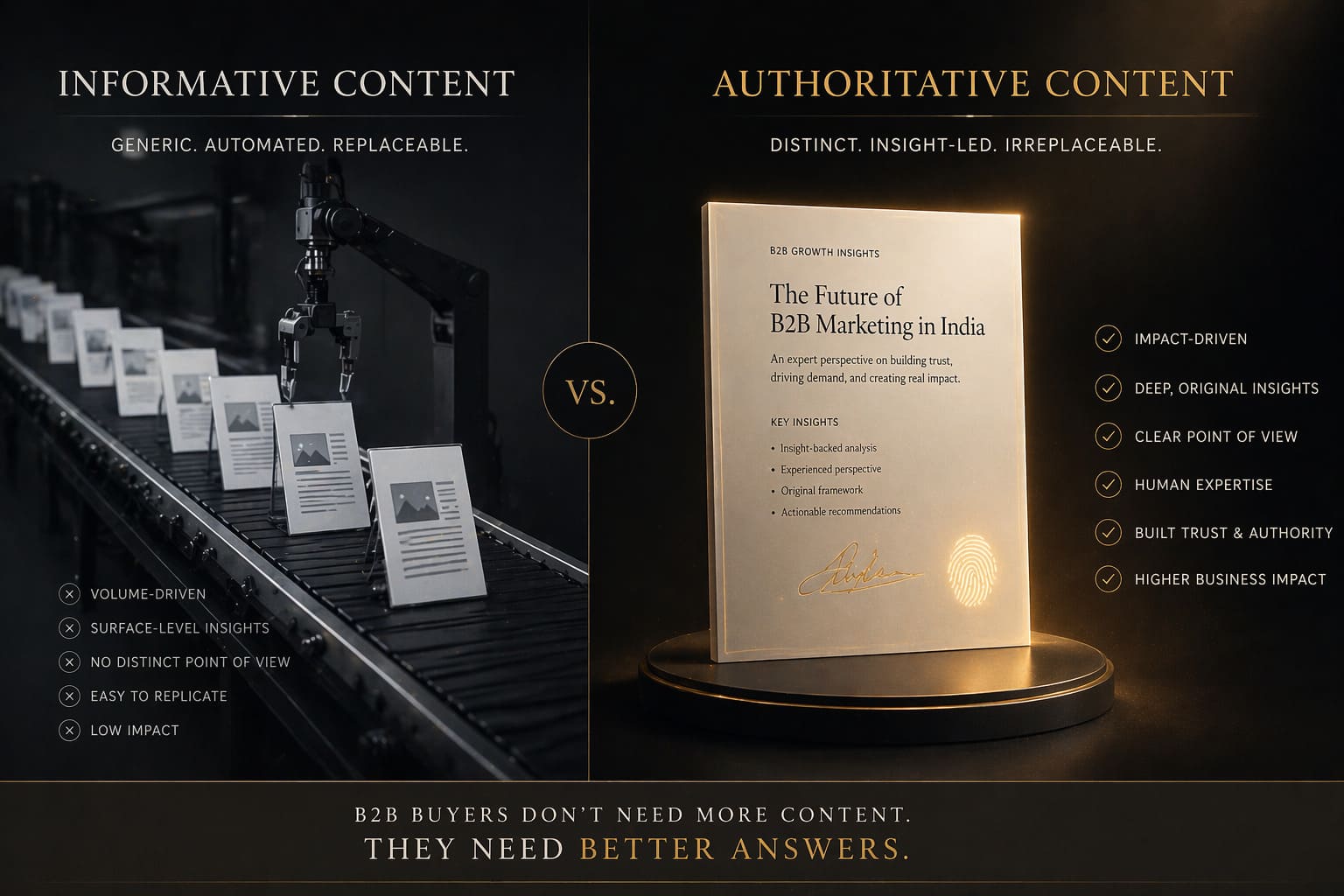
“Informative” is not a differentiator. Any AI tool can produce informative content in four minutes. Your competitors are already doing it.
What B2B Buyers Are Actually Doing Before They Talk to You
By the time a potential client emails your team or fills out your contact form, they’ve already formed an opinion about you. Probably a few opinions. They’ve read something you wrote, or read something your competitor wrote, or asked someone in their network whether they’ve heard of you.
According to research from FocusVision, B2B buyers consume an average of 13 pieces of content before making a purchase decision. Thirteen. And most of that research happens before they contact anyone.
In India, this dynamic is even more pronounced. Over 72% of Indian B2B buyers say vendor content directly influences their shortlisting decisions. LinkedIn India now has over 110 million professionals — the second-largest user base in the world. Your buyers are on it. They’re reading. They’re comparing. They’re forming opinions about which companies seem to actually know their domain and which ones are just filling their blog for the sake of publishing.
Here’s the uncomfortable part: most B2B content produced in India falls into the second category. Not because the companies are incompetent — most of them know their domain well. But because they confuse “writing about a topic” with “saying something about a topic.”
There’s a structural side to this too. A scattered message across that 13-piece research journey is its own kind of friction — my colleague Avinash breaks down exactly how that plays out in how strong B2B messaging reduces friction across the buyer journey. This piece is about the other half of the problem: even with a clear message, content that takes no position gives a buyer nothing to hold on to.
The Brief That Produces Bad B2B Content
This is what most content briefs look like, whether written out or just assumed:
“Write a 1,000-word blog post on [topic]. It should be informative, SEO-optimised, and relevant to our target audience of [very broad description].”
That brief will produce a piece that covers the topic. It’ll define the key terms. It’ll list some best practices. It’ll have a subheading for challenges and another for solutions. Technically accurate. Completely forgettable.
The problem is the word “informative.” Informative is not a differentiator. Any of your competitors can produce informative content. If the bar for your content is “it contains correct information,” you’re producing something the internet already has in abundance.
A good brief asks something harder: What is the one thing we believe about this topic that not everyone agrees with? What would we say to a smart, skeptical CFO who has heard the generic version of this argument before?
That’s a harder question. The answer to it is also the content that converts.
Informational Content vs. Authoritative Content
There’s a real difference, and it’s worth being precise about it.
Informational content answers “what.” It explains a concept, defines a term, outlines a process. It’s useful early in a buyer’s research. It’s findable through search. It builds surface awareness. You need some of it.
Authoritative content answers “why” and “so what.” It takes a position. It argues something. It demonstrates that the people behind the brand have spent serious time in a domain and have developed views that can’t be easily replicated. It’s the content that makes a buyer think: these people understand our problem better than we do.
Here’s the test. Read your last three blog posts and ask: does this contain an argument? Not a topic — an argument. A claim that someone could reasonably disagree with, backed with evidence and experience. If the answer is no, you’ve written informational content. It might rank. It will not convert.
The DemandSage 2026 B2B Marketing Statistics Report confirms this at scale: B2B blogs produce 67% more leads per post and convert at 2.1x the rate of B2C content — but only when the content reflects genuine domain expertise. The volume of B2B content published has never been higher. The percentage of it that actually converts has never been lower. Those two facts are related.
Read your last three blog posts. Does each one contain a specific argument — a claim someone could disagree with? If not, you’ve written informational content. It might rank. It won’t convert.
Why “Thought Leadership” Stopped Working
Almost every B2B company in India now claims to do thought leadership. It has become the default label for any content that isn’t a direct sales pitch. The problem is that most of it isn’t thought leadership — it’s opinion content with no thought behind it, or informational content repackaged as strategic insight.
Real thought leadership makes an argument your audience hasn’t heard before, or makes a familiar argument better than anyone else has made it. It’s specific. It shows its working. It references real situations, real data, real client outcomes. It can be wrong — good arguments can be wrong — but it has to be genuine.
LinkedIn’s 2026 B2B Marketing Benchmark found that 94% of marketers agree trust is now the primary currency in B2B. Nearly two-thirds of those surveyed said they need more distinctive, human-centred content to stand out. What that actually means in practice: buyers can tell the difference between a brand that genuinely thinks about their problems and a brand that merely produces content about their problems. One builds trust. The other fills a content calendar.
The same pattern plays out in every content audit we run — brands that were producing 12 posts a month with no clear argument are outperformed by brands producing four posts a month that each take a real position. Every time.
The Human-First B2B Formula
This is simpler than most content strategy frameworks make it sound.
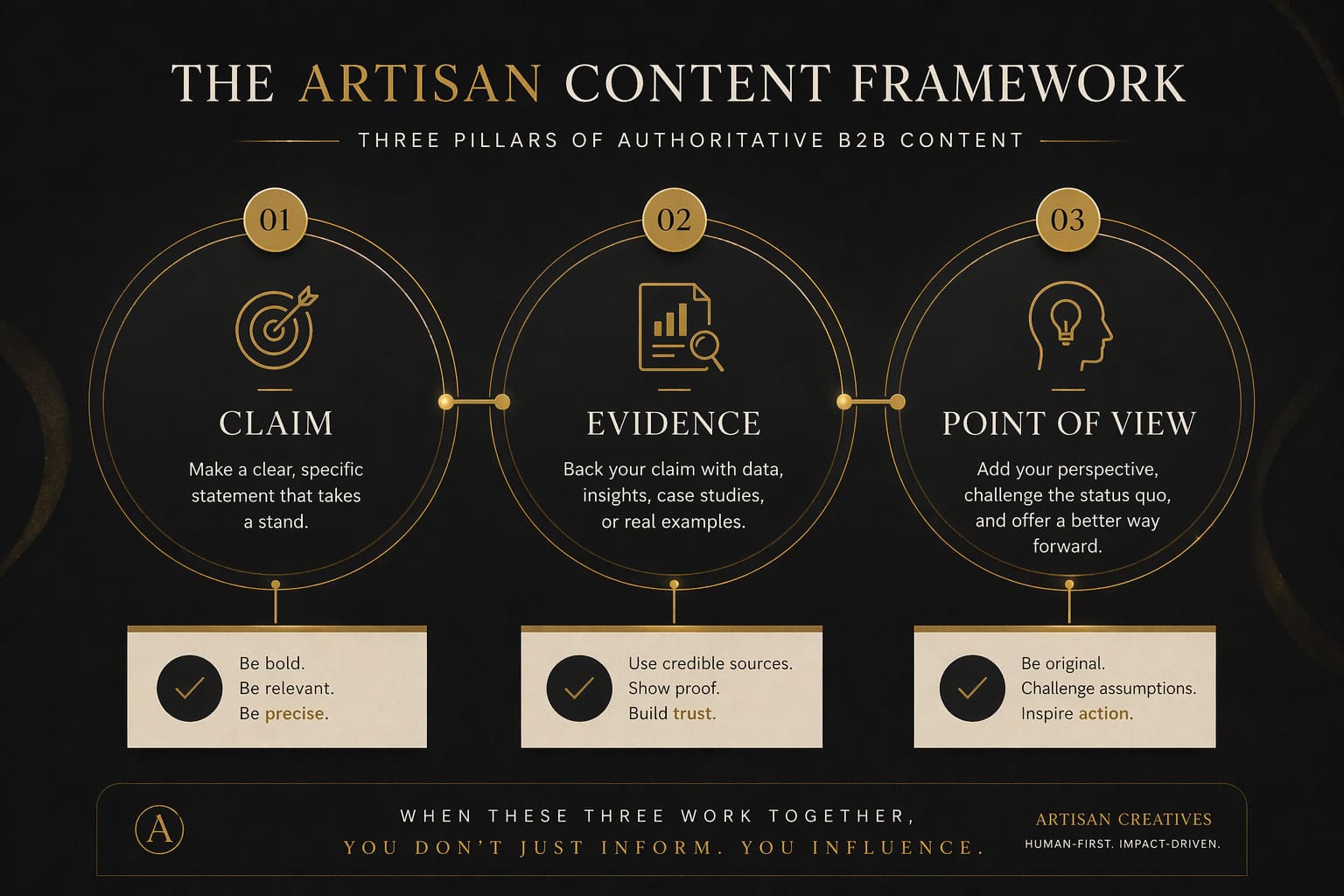
Every piece of B2B content that converts does three things. First, it makes a specific claim — not “content is important for B2B growth” but something like “most Indian SaaS companies are writing for awareness when their buyers are already at the decision stage, and that mismatch is why their content gets traffic but not meetings.” Second, it provides real evidence — a data point, a client outcome, a pattern observed across multiple engagements. Third, it has a point of view — a clear recommendation for what to do about it, written by someone who has actually done it.
Claim. Evidence. Point of view. Anything that doesn’t have all three is probably not converting.
This is what we mean at Artisan Creatives when we talk about the Human-in-the-Loop methodology — the idea that AI can compress timelines and scale production, but the actual intelligence in content has to come from a person who knows the domain. You can’t prompt your way to a point of view. You have to have one first.
Claim, evidence, and point of view are what a single piece needs. Holding that consistent across every touchpoint a buying committee sees is a discipline of its own — Avinash maps out the building blocks in clarity, consistency, and context in B2B messaging. Read together, the two ideas are the same argument from two angles: say something worth saying, and say it the same way everywhere.
Claim. Evidence. Point of view. Every B2B piece that converts has all three. If yours is missing one, that’s where the pipeline leak is.
What This Looks Like in Practice
The B2B companies in India whose content is actually working right now share a few habits.
They write for one reader. Not “decision-makers in mid-sized companies” — that’s a demographic. The best content briefs describe one actual person: the CTO at a Series B SaaS company who just had a board meeting where someone asked why marketing spend isn’t producing qualified pipeline. That level of specificity feels over-engineered until you read the content it produces. It sounds like you’re talking to that person directly. They forward it to two colleagues.
They publish less and say more. Content marketing now represents 26% of total marketing spend in 2026. The companies getting the highest return from that spend are not the ones publishing most often — they’re the ones treating every piece as an asset worth building properly and distributing deliberately.
They use their own experience as evidence. The most distinctive B2B content references specific situations: what happened when we audited a client’s content architecture, what changed when we rewrote a service page from features to outcomes, which format worked in a specific market and which fell flat. Specific beats general every time. Your competitors can’t replicate your experience.
This discipline also feeds directly into search visibility in 2026. Google’s EEAT framework rewards demonstrated experience. AI answer engines like Perplexity and Gemini cite specific, authoritative sources — not general ones. The same habit that makes your content convert also makes it rank and makes it citable by AI systems. This is especially true in high-trust industries where credibility is the purchase criterion — professional services, SaaS, consulting, fintech.
There’s also a zero-click reality worth naming here. A growing proportion of B2B research now happens in AI-generated summaries, LinkedIn feeds, and shared Slack threads — not on your website. Content that is specific, quotable, and authoritative gets cited and shared in those environments. Content that is generic does not. The distribution advantage goes to the brands willing to take a position.
Before You Write Your Next Piece
One question. Before the next blog post, whitepaper, or LinkedIn article gets assigned to anyone — answer this: what does this piece argue, specifically, and why would a smart, experienced buyer who has already read ten similar articles this month find our version worth finishing?
If the answer isn’t clear before writing starts, the brief needs to change.
It’s also worth being honest about what “content strategy” actually means. Most B2B companies have a publishing schedule. Very few have a content strategy — a documented system that maps specific pieces to specific buyer stages, with clear arguments assigned to each stage and a measurement framework to track whether those arguments are actually moving buyers forward. The instinct to keep producing without stepping back to evaluate is one of the most common and most costly content mistakes we see.
Building that kind of content system — not a content calendar, a content system — is the core of what we do with B2B clients at Artisan Creatives. It starts with the argument, not the word count. The Atelier has more on how we approach this across different types of brands, from scaling B2B companies entering new markets to established businesses taking their brand digital for the first time.
If your content is getting reads but not conversations, or your team is publishing consistently without producing pipeline — let’s talk. That gap usually has a fixable cause.
Frequently Asked Questions
Why does most B2B content fail to convert?
Because it fails before a word is written — the brief is wrong. When the goal is vague (“build thought leadership,” “educate our audience”), the content covers a topic without saying anything specific. It's informative but interchangeable with every competitor, which gives a buyer no reason to remember or contact you.
What is the difference between informational and authoritative content?
Informational content answers “what” — it defines terms and outlines processes, and any competitor or AI tool can produce it. Authoritative content answers “why” and “so what”: it takes a position, argues something, and demonstrates real domain expertise. Informational content might rank; authoritative content is what actually converts.
How much content do B2B buyers consume before deciding?
Research suggests B2B buyers consume an average of around 13 pieces of content before making a purchase decision, and most of that research happens before they contact anyone. In India, over 72% of B2B buyers say vendor content directly influences their shortlisting — so the opinion of you is largely formed before the first conversation.
What does B2B content that converts actually look like?
Every piece that converts does three things: it makes a specific claim someone could disagree with, backs it with real evidence (a data point, a client outcome, an observed pattern), and carries a clear point of view from someone who has actually done the work. Claim, evidence, point of view — anything missing one of the three usually isn't converting.