The 2026 State of Digital Marketing in India: Why AI Is Forcing Brands Back to Human-First Strategies
Sai Digbijay Patnaik | Apr 6, 2026
Co-Founder
⚡ The Artisan Summary
- → The Core Problem: AI flooded Indian marketing with cheap, fast, identical content — and in doing so, destroyed the one thing brands actually need: audience trust.
- → The Strategy: The brands winning in 2026 aren't the ones producing the most content. They're the ones producing content that sounds like it came from a human who actually knows something — and pairing that with the technical infrastructure to get it seen.
- → The Impact: Human-first strategy backed by AI infrastructure is now the only formula that works across India's uniquely complex, multi-language, multi-tier market — and it rewards brands that build for depth over volume.
India's digital marketing industry crossed ₹69,856 crore in ad spend in 2026. Over 900 million people are now online. AI tools have made it possible to produce a month's worth of content in a single afternoon. By every measurable metric, the conditions for marketing success have never been better.
And yet, something broke.
Somewhere between the AI content boom, the programmatic ad explosion, and the race to publish more, faster, brands started losing their audiences. Not abruptly. Quietly. Engagement numbers stagnated. Conversion rates softened. Social reach climbed while meaningful interaction fell.
The content was technically fine. The targeting was sophisticated. But the content had no fingerprint — no evidence that a real person with a real perspective made it. This is the central tension in Indian digital marketing right now. More capability, less connection.
And the industry is only beginning to reckon with it honestly.
The Numbers Behind India's Digital Marketing Moment
Before we talk about what's broken, it's worth understanding the scale of what's been built.
India is the second-largest online market in the world, behind only China. The digital advertising market, valued at USD 6.71 billion in 2025 according to Expert Market Research, is projected to grow at a CAGR of 30.2% through 2035 — potentially reaching USD 93.94 billion. The dentsu-e4m Digital Advertising Report puts India's digital ad spend at ₹69,856 crore by 2026, accounting for over 61% of total advertising expenditure. Digital media is also on track to become the first media and entertainment segment in India to cross ₹1 trillion in ad revenues this year.
The infrastructure story is just as significant. India leads global AI adoption at 30%, outpacing the world average of 26%. The Indian AI market has grown from USD 3.2 billion in 2020 to USD 6.05 billion in 2024, and by 2031, analysts project it will reach USD 31.94 billion.
AI adoption inside Indian marketing teams has moved from experiment to default. Most of the SEO, content, and social teams we talk to aren't piloting AI anymore — they're running it daily. B2B SaaS teams are usually furthest along, with AI built into content production and lead nurturing as standard infrastructure, not a side project.
By any measure, India's digital marketing ecosystem is one of the fastest-growing in the world. That's not a bold claim. It's a data point.
What the data doesn't capture is what's happening to trust.
The AI Content Flood and Its Real Cost
Here's the pattern that matters more than the growth figures.
Founder after founder tells us some version of the same story: output went up, engagement went flat or dropped. The common thread, every time, is publishing AI-generated content directly — without human review, editing, or a point of view layered on top. The output was fast, the volume was high, and it did nothing.
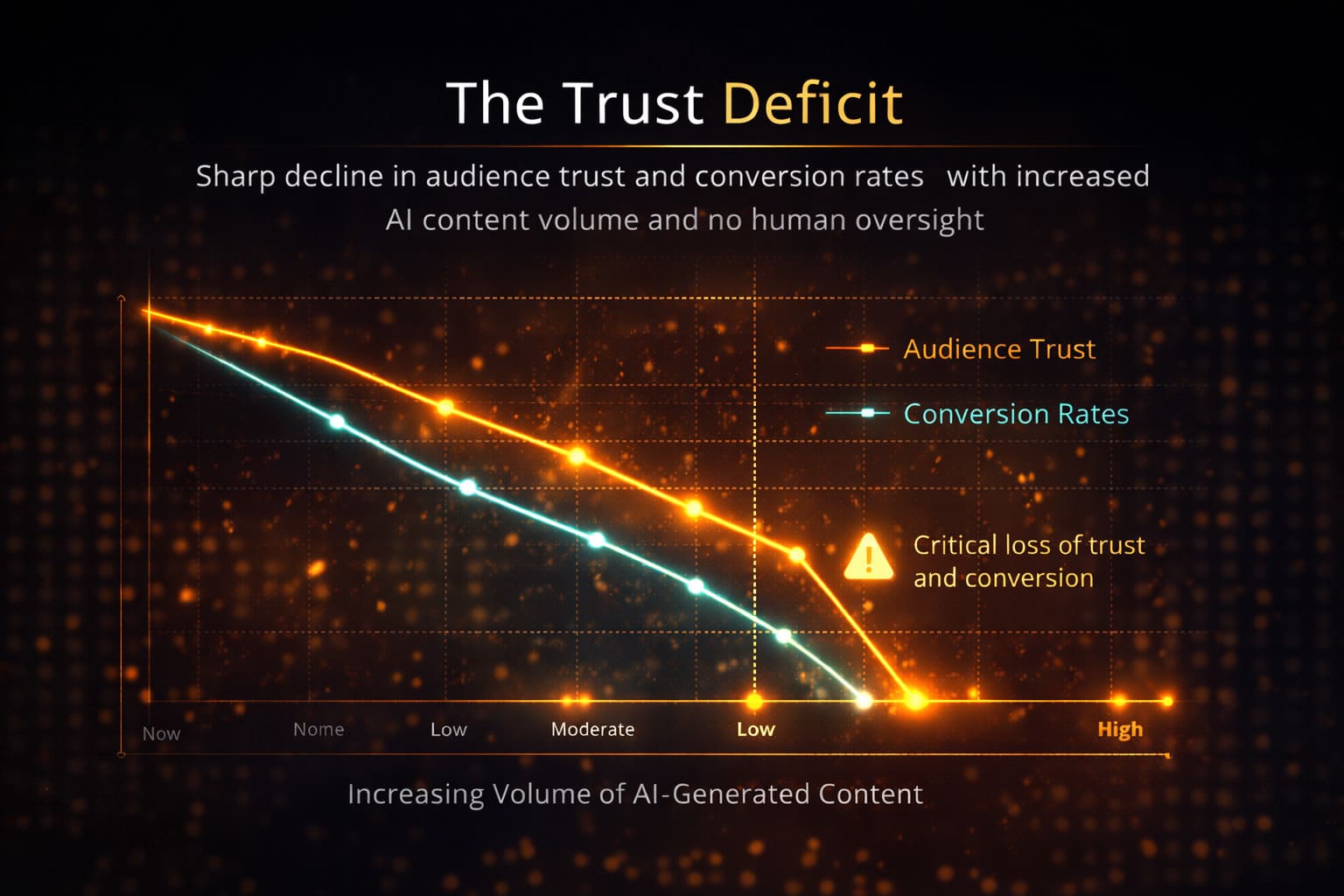
This isn't an argument against AI. AI is infrastructure now — it's not optional, and any agency telling you otherwise is selling something. The argument is against AI as a replacement for human thinking, which is a different thing entirely.
What happened in 2025 and into 2026 is that content production became effortless right at the moment every brand's competitor was also getting effortless content production. The result was a feed full of material that covered the same topics, hit the same angles, used the same transitional phrases, and reached roughly the same conclusions. Readers didn't need to articulate why it felt hollow. They just stopped engaging.
We've written about this pattern directly — it's what we call the digital declutter. The brands that recognised it early made a deliberate choice: fewer pieces, stronger perspectives, more specific expertise. The ones that didn't are still wondering why their metrics look flat despite a growing audience.
The 27% of businesses that saw positive ROI from AI? They all used it the same way: AI generates the first draft, a human with genuine domain knowledge refines it, adds perspective, strips the generic language, and makes it say something worth reading. That's the human-in-the-loop methodology — and in 2026, it's not a nice-to-have. It's the only version of AI-assisted content that actually works.
What Google and AI Search Engines Are Actually Rewarding
The algorithm story in 2026 is cleaner than most people expect. Google's EEAT framework — Experience, Expertise, Authoritativeness, Trustworthiness — has been tightening its grip on what ranks.
The practical implication is straightforward: content that can demonstrate first-hand experience with a topic, cite verifiable sources, and show that an actual expert wrote it gets rewarded. Content that reads like it was assembled by a tool optimising for keyword density gets ignored, or worse, filtered.
This matters even more in generative search. When ChatGPT, Perplexity, or Google's AI Overviews answer a question, they're pulling from sources they consider credible — not just highly-ranked. Generative Engine Optimisation (GEO) is the discipline of making your content citable by those AI answer engines.
The brands showing up in AI-generated answers aren't the ones who published most often. They're the ones whose content was specific, authoritative, and human-authored enough that the model trusts it as a source.
The irony is real: the more AI-generated content floods the web, the more valuable genuinely human content becomes — both to audiences and to the AI systems indexing the web. Next-gen digital marketing runs on this logic. Human authority signals are now a technical SEO asset, not just a creative virtue.
If you're not sure where your own site stands against these signals, our free Content Audit Checklist walks through the twenty-five fundamentals — technical SEO, authorship, structured data, and AI-era discoverability — that most brands assume they've covered and haven't.
India's Unique Complexity: Why Generic Strategies Fail Here
Everything above applies globally. What makes India different — and what makes human-first strategy particularly non-negotiable here — is the market's structural complexity.
India has 22 officially recognised languages. It has Tier 1 cities with digital consumption patterns that look like Western Europe, and Tier 2 and Tier 3 cities with entirely different platforms, entirely different purchase journeys, and entirely different trust signals.
AI tools have made regional-language content production cheap and fast for Tier 2 and Tier 3 markets — Hindi, Telugu, Tamil, and more. But using AI to translate English marketing materials into regional languages is not the same as understanding what actually resonates with those audiences.
This is where cultural SEO becomes a strategic necessity rather than a nice extra layer. Translation is not localisation. Localisation is not strategy. A brand that wants to grow across India's markets — not just the English-speaking metros — needs content that understands cultural context at the level of instinct.
The reference points, the aspirations, the specific anxieties of a consumer in Vizag are not the same as those of a consumer in Gurugram. No template captures that. Only human intelligence does.
The influencer marketing data makes the same point from a different direction. India's influencer market is projected to reach ₹3,375 crore by 2026, growing at 18% annually. But the growth isn't in celebrity endorsements — 47% of brands now prefer micro-influencers because they produce more authentic content that actually resonates with regional audiences.
A Mumbai-based micro-influencer with 11,000 followers routinely outperforms macro-influencers with millions because the audience trusts them. Reach without trust is just noise.
The same dynamic playing out in influencer marketing is playing out across every channel. India's audiences — increasingly sophisticated, increasingly sceptical, increasingly equipped to distinguish manufactured from genuine — are rewarding brands that communicate like real people, not marketing systems.
The Trust Deficit: Brands That Gained Visibility and Lost Credibility
There's a line from a January 2026 industry analysis that's worth sitting with: brands produced more content, launched more campaigns, and adopted more automation than any previous year combined — and simultaneously became harder to distinguish from each other.
Visibility went up. Credibility went down. That's the trust deficit.
It's not just an Indian problem, but India's market amplifies it. When consumer trust erodes in a market as diverse and value-conscious as India, it doesn't just affect conversion rates. It affects brand equity in ways that take years to rebuild.
Indian consumers in 2026, as noted in a Manifest Media analysis on brand trust, aren't just evaluating what a brand sells — they're evaluating whether the brand behaves consistently, acknowledges failure when it happens, and communicates with transparency rather than performance.
When AI-generated content or automated processes are presented as genuine human communication, and audiences eventually sense the difference — and they do sense it — trust erodes fast. The brands navigating this well are the ones that use AI transparently: for efficiency, for scale, for data processing — while keeping human voices, human judgment, and human accountability at the front of every customer interaction.
We explored what this looks like in practice in The Perfection Trap. The instinct to over-produce, over-polish, and over-automate content is the exact instinct that strips it of the rawness that makes it believable. The best-performing content in 2026 doesn't look factory-made. It looks authored.
The Channels Reshaping Indian Digital Marketing in 2026
Search: Beyond Google
Over 50% of Indian users now use voice search, at twice the global average. Voice queries are conversational, intent-driven, and heavily regional. A brand optimised only for typed English keywords is invisible to half its potential audience. Add to this the rise of AI-generated search responses, and the implication is clear: content strategy must now account for how AI answer engines will interpret and cite your content, not just where you rank in a list of blue links.
Social Media: Depth Over Frequency
Video consumption accounts for approximately 55% of mobile activity in India. Short-form video dominates, but the shift in what performs within short-form is telling: it's not production value driving engagement. It's authenticity, specificity, and personality. The brands gaining ground aren't the ones posting daily — they're the ones posting consistently with a recognisable voice and a clear perspective. Content calendars in 2026 are shifting from frequency obsession to consistency discipline.
B2B Content: Expertise Is the Product
India's B2B digital marketing space is where the human-first premium is most stark. B2B content strategy that produces whitepapers, case studies, and executive articles written by people who actually understand the industry — not assembled from public data — is outperforming templated content by a significant margin. Buyers in B2B contexts are making high-stakes decisions. They don't need more information. They need to trust the source of the information.
Regional Markets: The Next Frontier
The next major growth chapter in Indian digital marketing is outside the metros. Tier 2 and Tier 3 cities are generating new internet users faster than any other segment. Brands that reach these audiences effectively — with content in their language, using reference points from their context, through creators they already trust — have a window to build the kind of early loyalty that's very hard to dislodge. Brands that try to reach them with metro-optimised, English-first content scaled through automation will miss the window entirely. The Global Village Paradox is this exactly: the reach is there, but reach without authentic resonance accomplishes nothing.
What Winning Brands Are Actually Doing Differently
The pattern across India's best-performing digital marketing strategies in 2026 is consistent enough that it's worth making explicit.
- They've stopped measuring success by volume. The question isn't "how many pieces did we publish?" — it's "what does this piece do that no other brand could produce?" That's a fundamentally different brief to give a content team, and it produces fundamentally different output.
- They've invested in genuine expertise at the content layer. Not just editors. Actual subject matter experts contributing to strategy, writing, and review. This is the thing AI cannot manufacture: specific, lived, verifiable knowledge about something real.
- They've built for multi-channel presence with a consistent signal. In 2026, AI systems and audiences alike reward brands that feel coherent across touchpoints. A brand that sounds different on LinkedIn than on its blog, or whose ads don't connect to its website content, creates friction that the algorithm notices and audiences feel. Consistency compounds. Fragmentation erodes.
- They've treated human-first as a technical strategy, not just a creative value. EEAT compliance, GEO optimisation, structured data, authoritative internal linking — these aren't separate from human-first strategy. They're the infrastructure that makes human-first content findable. The two reinforce each other.
The Artisan Creatives View From Odisha
There's something clarifying about watching Indian marketing shift from where we sit — a creative agency built in Berhampur, Odisha, operating across markets most agencies in Mumbai or Bengaluru wouldn't claim as home territory.
The pattern we've seen consistently: brands that invested in genuine storytelling, specific expertise, and cultural intelligence are growing. Brands that scaled AI content without human oversight are quiet about their results.
At Artisan Creatives, this is what we've always been built around. We combine creativity, strategy, and execution for brands that want their marketing to actually mean something to the people they're trying to reach. That approach — brand craftsmanship with purpose — isn't a reaction to the AI moment. It was always the right way to do it. The AI moment just made it the only way that works.
If you're a brand navigating what marketing in India looks like in 2026 — figuring out where AI should actually sit in your content process, how to reach audiences across India's diverse markets, or how to build the kind of trust that actually converts — let's talk. We've been thinking hard about these questions for a while.
Frequently Asked Questions
Why is AI pushing brands back to human-first strategies in 2026?
Because the flood of AI-generated content made generic output worthless. When everyone can produce fluent, correct, personality-free copy instantly, audiences and search engines both start filtering for the opposite: genuine expertise, a named author, a real point of view. The scarce, valuable thing became human judgment, not production volume.
What are Google and AI search engines actually rewarding now?
Demonstrated experience and authority — Google's E-E-A-T signals, named authorship, original claims, and verifiable expertise. AI answer engines selectively cite content with a clear point of view and specific data, while summarising generic aggregation into nothing. Content that proves real knowledge wins; content that merely covers a topic disappears.
Why do generic marketing strategies fail in India specifically?
Because India isn't one market — it's many, layered by language, region, platform, and buyer behaviour. A strategy that ignores that complexity produces content that fits nowhere in particular. Winning in India means accounting for local intent and cultural context, not importing a one-size template built for a different market.
What are winning Indian brands doing differently in 2026?
They publish less but with more conviction, lead with a genuine point of view, invest in demonstrable expertise over output volume, and treat trust as the primary currency. They build authority that both human buyers and AI answer engines recognise, rather than chasing visibility that arrives without credibility.