The Human-in-the-Loop Algorithm: A Blueprint for Marketing in the AI Era
Sai Digbijay Patnaik | Jan 07, 2026
Co-Founder

⚡ The Artisan Summary
- → The Core Problem: Fully automated AI marketing lacks soul and fails to build genuine brand trust.
- → The Strategy: Implement the Human-in-the-Loop workflow—using AI for data and structure, but human experts for storytelling and connection.
- → The Impact: Scalable marketing output that preserves authenticity and drives higher B2B engagement.
If you have scrolled through LinkedIn, read a Medium article, or searched for a recipe recently, you have felt it. A vague sense of déjà vu. The polished but hollow sentences. Welcome to the "Content Sludge" of 2026.
A growing share of indexed Google search results are now AI-generated. The barrier to entry for creating content has dropped to zero. Anyone with an internet connection can churn out 50 blog posts a day. But here is the paradox: as the quantity of content has exploded, the trust in that content has plummeted.
More consumers are actively looking for "signs of humanity" before they engage with a brand. They are tired of the perfection. They are tired of the predictability. They crave the messy, opinionated, specific texture of a real human voice.
At Artisan Creatives, we believe this moment—right now—presents a once-in-a-generation opportunity for heritage brands, local artisans, and purpose-driven businesses. While the rest of the world zigs towards automation and generic scale, you have the chance to zag towards humanity and depth. We call this strategy "The Human-in-the-Loop" (HITL).
1. What is the Human-in-the-Loop?
The Human-in-the-Loop is not a specific piece of software. It is a philosophy and a workflow. It is the fundamental recognition that Artificial Intelligence is an incredible engine, but it makes a terrible driver.
- AI Excellence: Speed, pattern recognition, data synthesis, formatting, and grammar. It can summarize a 50-page report in seconds.
- Human Excellence: Context, empathy, irony, cultural nuance, judgment, and "taste." A human knows why a joke is funny. A human knows why a specific shade of indigo matters to a weaver in Sambalpur.
The HITL strategy demands that AI never touches your audience without passing through a human filter first. It is the difference between a factory-made plastic chair and a chair that was cut by a machine but finished, sanded, and varnished by a master carpenter. One is a commodity; the other is a craft.
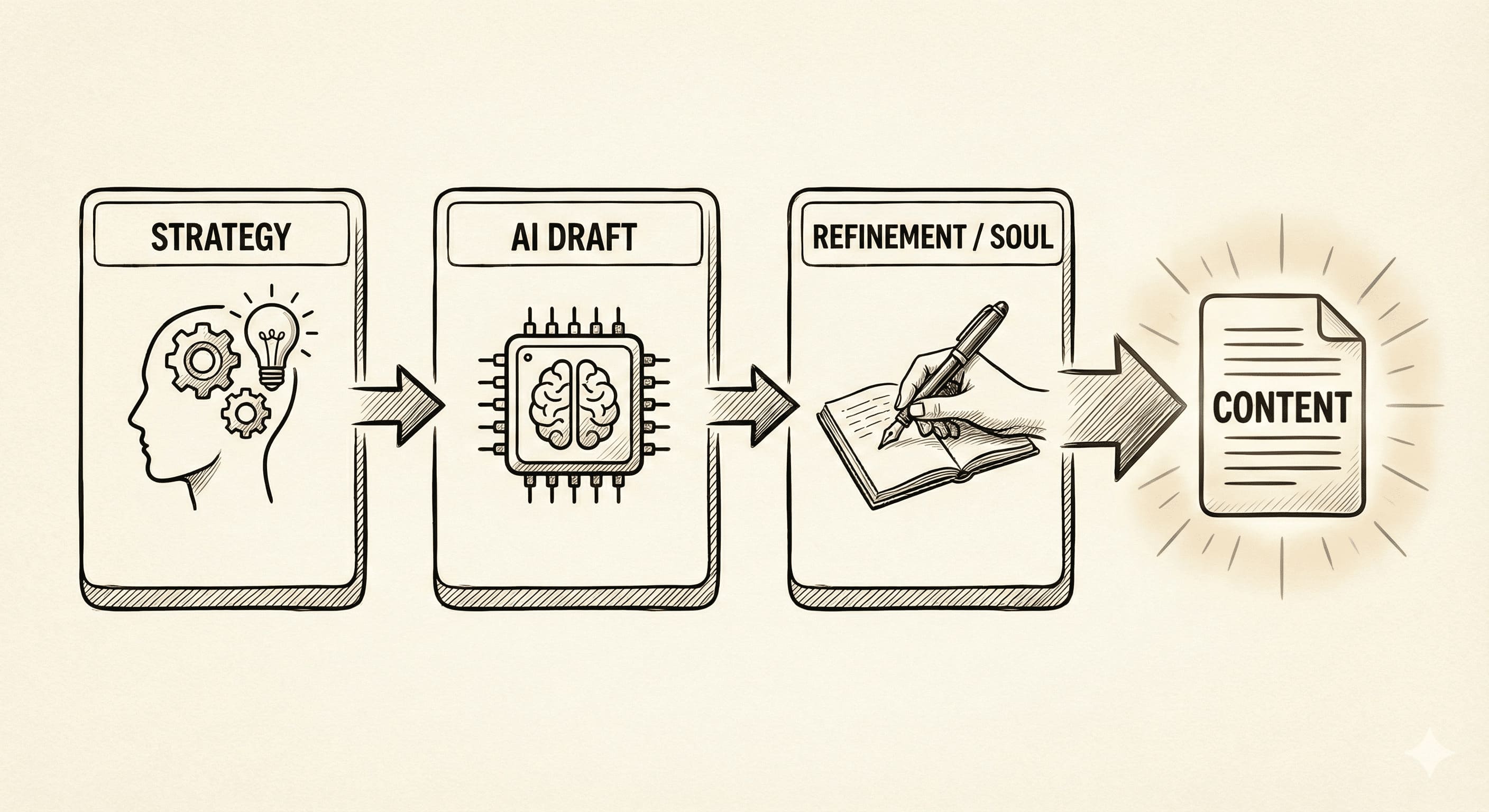
2. The 3-Step HITL Workflow
Many businesses fail because they try to replace their marketing team with AI. This is a mistake. To scale your local brand globally without losing your soul, you need to implement these three distinct layers of production:
Layer 1: The Brief (100% Human)
This is the most common failure point. Never ask an AI to "come up with a strategy for me." That is your job as the leader. You must define the Why.
For example, if we are marketing for a Pattachitra artist in Odisha, the strategy isn't simply "sell more paintings." The strategy is "preserve a 12th-century storytelling tradition by making it relevant to modern decor." AI cannot feel the weight of that heritage. It doesn't know the smell of the natural colors or the sound of the village. You do. Your brief must be pregnant with this context.
Layer 2: The Draft (AI + Human)
This is where we leverage the machines for efficiency. Once the human direction is set, use AI to do the heavy lifting. Use it to structure your thoughts into a logical outline, analyze keyword data to find gaps in the market, or draft the boring technical code.
This layer is about Velocity. It prevents the "blank page syndrome" that stops so many creators.
Layer 3: The Refinement (The "Soul" Pass)
This is the non-negotiable step. Before you hit publish, a human editor must review the output and add the "texture." This "Soul Pass" usually takes 20% of the total time but provides 80% of the value. It's exactly the operating model behind our Content Management practice — AI accelerates the workflow, but nothing ships without a human signing off on the soul.
- Add Local Flavor: Does the copy use idioms, metaphors, or references specific to your region? If you are an Indian brand, does it sound like us, or does it sound like a generic American textbook?
- Check Reality: AI is a "stochastic parrot"—it often hallucinates facts. Did you actually get that 300% ROI for the client, or did the AI just invent a nice number?
- Inject Opinion: AI is neutral. Great brands are not. AI will say, "There are many ways to do SEO." A human expert will say, "Most people do SEO wrong; here is the right way."
3. Why Google Loves "Experience" (E-E-A-T)
If the "human connection" argument feels too soft for you, let’s talk about hard business metrics. Let’s talk about SEO.
In 2026, Google’s ranking algorithm has evolved significantly. It is obsessed with the concept of E-E-A-T: Experience, Expertise, Authoritativeness, and Trustworthiness. The most important addition here is the first E for Experience.
Google knows that an LLM can scrape the internet and write a technically perfect guide on "How to weave a saree." But an LLM cannot write about "How my back ached after 12 hours at the loom" or "The specific joy of seeing the pattern emerge."
That first-hand experience—the "I was there" factor—is what Google now prioritizes. By ensuring a human is in the loop, adding personal anecdotes, verified expertise, and unique photos, you signal to search engines that you are a primary source, not just a content farm reposting existing information.
It's the same signal we unpack in why trust is the ultimate ranking factor for B2B brands — E-E-A-T isn't a checkbox. It's a description of what buyers already look for before they'll trust you with a contract.
4. The Business Case: Efficiency vs. Effectiveness
We often hear business owners say, "But AI is so much faster. I can get 50 blogs for the price of one." This is the trap of confusing Efficiency (doing things fast) with Effectiveness (doing the right things).
A generic AI blog might take 5 minutes to create. It might get 1,000 views. But if it is generic, it builds zero trust. It results in 0 leads. A HITL article—rich with story, emotion, and expertise—might take 4 hours to create. It might get only 100 views. But because it proves your competence and connects emotionally, it might generate 5 high-value clients.
In the B2B and luxury space—where Artisan Creatives operates—Trust is the only currency that matters. You cannot automate trust.
Conclusion: Be the Cyborg, Not the Android
The future of marketing isn't Human vs. AI. That creates a false dichotomy. The future is Human + AI. The brands that dominate in 2026 will be the ones that have the discipline to use the algorithm to reach the world, but the courage to use their soul to connect with it.
Are you ready to build a digital presence that feels like home? Contact Artisan Creatives today.
Frequently Asked Questions
What is Human-in-the-Loop marketing?
Human-in-the-Loop (HITL) is a content methodology where AI handles the research layer — trend data, competitor gaps, technical SEO signals — and a human handles everything requiring judgment: the writing, the brand voice, the strategic framing. No piece leaves the studio without a person shaping it and signing off, so the output reads like writing, not output.
How does the Human-in-the-Loop workflow actually work?
It's a three-step loop: AI compresses the research and groundwork, a human strategist shapes the argument, voice, and point of view, and a human reviews and signs off before anything publishes. AI scales the production; the intelligence and accountability stay with a person who knows the domain.
Why does Google's E-E-A-T reward human-led content?
Because E-E-A-T rewards demonstrated Experience, Expertise, Authoritativeness, and Trust — signals that come from a real person with real knowledge, not from automated output. Content with a named author who takes positions and shows genuine experience consistently outperforms generic AI-generated copy that aggregates what's already online.
Is Human-in-the-Loop just slower, more expensive content?
No — it's the balance of efficiency and effectiveness. Pure automation is cheap but produces forgettable, generic content audiences clock instantly. Pure manual work doesn't scale. HITL uses AI to move fast on the groundwork while keeping a human in control of the part that actually earns trust and converts.