The Post-Geographic Agency: Why Global Brands Are Seeking "Human-First" Digital Partners
Sai Digbijay Patnaik | Mar 12, 2026
Co-Founder

⚡ The Artisan Summary
- → The Core Problem: Every agency now has the same tools and templates, making most digital content indistinguishable — and leaving global brands struggling to find a partner with a real point of view.
- → The Strategy: The brands winning in 2026 are choosing human-first creative partners based on cultural intelligence, strategic depth, and genuine craft — not zip codes or rate cards.
- → The Impact: Post-geographic agencies built on human judgment — not just AI output — produce content that builds trust, drives engagement across markets, and performs in both traditional and generative search.
A brand in Toronto is working with a content team in Bhubaneswar. A SaaS company in Amsterdam just signed a strategy partner from Odisha. This isn't an anomaly. It's the new default — and it's changing what "choosing an agency" actually means.
There used to be a simple filter: if you were a serious brand, you hired a serious agency. And "serious" meant a glass-walled office in a major metro, a recognizable city name in the email signature, an hourly rate that justified the skyline view. Geography was shorthand for credibility.
That filter is gone. Not fading. Gone. The brands that understood this first are already three years ahead of those still running agency RFPs limited by zip codes. And the question every CMO is quietly asking in 2026 isn't "where are they based?" It's something harder to define and far more important: do they actually think like humans?
What “Post-Geographic” Actually Means
The post-geographic shift isn't really about remote work, though that accelerated it. It's about a more fundamental change in how brands evaluate creative partners.
When the internet removed friction from collaboration, it should have leveled the playing field for agencies worldwide. In some ways it did. But it also flooded the market. Anyone with a laptop and access to the same AI tools can now produce the same templated blog posts, the same carousel graphics, the same five-step content strategies. The barriers to entry collapsed — which means the barriers to differentiation went up.
A global brand today isn't struggling to find an agency. They're struggling to find one that doesn't feel like every other agency. That's the actual problem, and it's why "human-first" stopped being a tagline and became a genuine procurement criterion.
The Sameness Crisis No One Talks About Honestly
Here's something worth sitting with: when every brand has access to the same tools, the same templates, and the same AI-generated content frameworks, the output starts to look identical. Not just similar. Genuinely interchangeable.
We wrote about this directly in The Global Village Paradox — the internet has flattened the world, but it has also created a sea of sameness. A weaver in Bihar can now sell to Paris. A cloud kitchen in Bhubaneswar can build a brand that rivals international franchises. The reach is real. But the moment everyone uses the same templates, that reach stops doing anything useful.

Global brands feel this most acutely. They're operating in multiple markets, managing multiple audiences, and watching their engagement numbers stagnate even as their content output climbs. More content, less signal. The problem isn't volume — it's that the content has no fingerprint. No evidence that a human being with a distinct perspective made it.
And this, more than anything else, is what's driving the shift toward human-first digital partners.
What “Human-First” Actually Requires
It's easy to say "we're a human-first agency." Most decks do. What's harder is building a practice where that claim holds up under scrutiny — or better, where it holds up once a client starts actually working with you.
Human-first digital marketing means the strategy begins with a person. A real customer, a real cultural context, a real communication gap. Not a keyword list. Not a content calendar template someone built from a webinar download two years ago. The creative work should have a point of view, not just a "tone of voice." It means someone on the team has genuinely thought about why a particular message will land differently in Bangalore than in Berlin, and they've built that difference into the work before the brief was finalized.
This is where most agencies fail quietly. They produce globally formatted content: clean, competent, completely neutral. It offends no one and moves no one. Cultural SEO is a useful lens here — translation isn't localization, and localization isn't strategy. A brand that wants to grow across markets needs content that understands cultural context at the level of instinct, not just instruction.
Human-first also means the relationship between brand and agency looks different. Less transactional, more collaborative. The best partnerships aren't structured around deliverable counts — they're built around shared understanding of what the brand is actually trying to accomplish, and a team willing to push back when the brief is wrong.
The Human-in-the-Loop Advantage
AI has changed content production permanently. Any honest agency will tell you they use it. The question is where human judgment re-enters the process — and how much of the real thinking still happens with a person behind it.
We've written about this in depth in The Human-in-the-Loop Algorithm, but the short version is this: the brands seeing the best results from AI-assisted content aren't the ones letting it run freely. They're the ones using it as infrastructure while keeping humans in control of strategy, voice, and judgment.
The agencies winning global accounts right now have figured out the same thing. They use AI to compress timelines on production. They keep humans in charge of the questions that actually matter: What does this brand stand for? What does this audience need to hear? Why would anyone care? Those questions don't have algorithmic answers, and the brands that have been burned by pure-AI content shops know it.
As we noted in our 2026 digital strategy guide, the goal now isn't to be the loudest brand in the room. It's to be the most trusted. That trust gets built by content that sounds like it came from someone who actually knows something — and cares whether it lands.
Why Smaller, Craftsman-Style Agencies Are Closing Enterprise Deals
Mid-sized global brands are regularly passing over large agency networks in favor of smaller, more specialized creative shops. Not always. But often enough that the pattern has a name now, even if the industry doesn't like to say it out loud.
Part of it is economics. Large agency holding companies carry overhead that shows up in the rate card before a single brief is written. But the more interesting reason is strategic depth per engagement. At a large network, your brand might be the fifteenth-largest account in the office. At a craftsman-style agency, it might be one of five. The level of attention is structurally different.
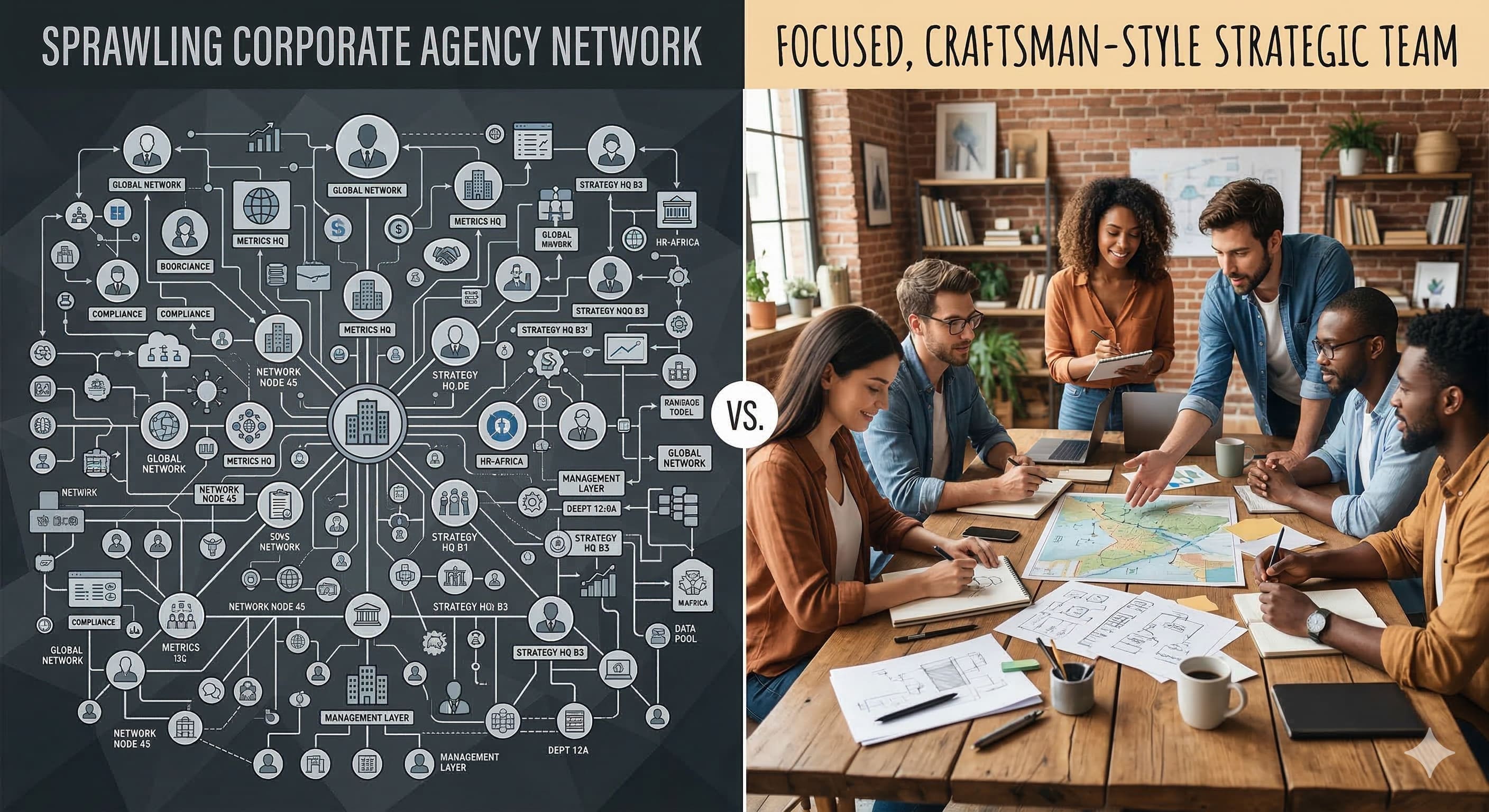
The other factor is authenticity in the output. Smaller teams with a defined point of view produce work that sounds like something — a perspective, a voice, a consistent logic. That's harder to manufacture at scale. Rawness, in fact, often wins — brands that try to produce perfectly polished content at volume end up with work that feels assembled rather than authored.
This is the model Artisan Creatives was built around. We are a creative digital marketing agency from Odisha — not despite that geography, but because of what it requires. Operating outside the traditional agency capitals means you earn accounts on the strength of the work, not the address. Your thinking has to be sharper, your strategy has to be clearer, and your storytelling has to be good enough to cross whatever distance exists between you and the client.
From Odisha to the world isn't a slogan. It's the actual proof of concept.
GEO, AIO, and the New Rules of Brand Visibility
For brands operating across multiple markets, the visibility problem has gotten more complex. It used to be SEO: rank on Google, drive traffic. That's still part of it. But search behavior has fragmented across TikTok, Reddit, AI assistants, Instagram, and local discovery platforms in ways that a pure Google-first strategy doesn't capture.
Generative Engine Optimization (GEO) is the practice of making your brand's content citable by AI answer engines — the kind powering ChatGPT, Gemini, and Perplexity when someone asks a question in natural language. If your content doesn't appear in AI-generated answers, you're invisible to a growing segment of high-intent users who never reach a search results page at all.
What makes content GEO-ready is largely the same thing that makes it genuinely valuable: it answers specific questions clearly, demonstrates real expertise, and covers topics with depth rather than breadth. Human-first content and GEO-ready content are not different disciplines. They're the same one, approached with the same rigor.
The next generation of digital marketing runs on exactly this logic — AI for scale and efficiency, humans for authority and trust, and content built to perform across both traditional and generative search environments.
What Global Brands Should Ask Before Signing Any Agency in 2026
If you're evaluating creative partners this year, these are the questions worth asking before you look at rate cards or case study decks.
Do they have a documented content philosophy, or just a portfolio? Portfolios show what an agency has produced. A philosophy shows how they think — and thinking is what you're actually hiring.
Can they explain cultural context, not just content format? A partner who can tell you why a message lands differently in different markets, and build that into the brief, is worth far more than one who can replicate a successful format across regions.
How do they use AI, specifically? The honest answer involves specifics about where human judgment re-enters the process — not a generic claim about "AI-enhanced creativity."
What do they push back on? Agencies that agree with everything in the brief aren't partners. They're vendors. The best creative relationships involve friction — someone willing to say "that's not the right brief" before spending three months executing the wrong thing.
The post-geographic agency era means the best partner for your brand might not be in your city, your country, or your timezone. What they will have is a clear point of view, a genuine understanding of your audience, and the craft to put both to work.
That's what we do at Artisan Creatives. We shape stories and sculpt brands — combining creativity, strategy, and execution for clients who need the work to actually do something. If you're building a brand that needs to matter to real people, across real markets, let's talk about the brief.
Frequently Asked Questions
What is a post-geographic agency?
A post-geographic agency is one whose value comes from the quality of its thinking, not its postcode. The internet doesn't care where the office is; it cares whether the work is good. A boutique studio in Odisha can serve a brand in Europe because strategic depth and senior attention travel, while overhead and layers don't have to.
Why are global brands seeking human-first digital partners?
Because of a sameness crisis: automation-first and network agencies increasingly produce interchangeable work. Global brands that want a distinct voice are looking for partners who lead with human judgment and craft — senior strategic thinking applied directly, rather than production at volume run through templates.
Why are smaller, craftsman-style agencies winning enterprise deals?
Because they offer founder-level attention and strategic depth that large agencies structurally can't give a mid-size client. No layers between strategy and execution, direct access to the people doing the thinking, and a willingness to take a real position. For brands that value craft over scale, that's the advantage.
What should a global brand ask before signing an agency in 2026?
Ask who will actually do the work, whether the agency leads with strategy or just production, how it approaches GEO and AIO so the brand stays visible in AI answer engines, and whether there's a human point of view behind the content. The answers separate a craft partner from a content factory.