Why Your Brand Has No Voice Online
Sai Digbijay Patnaik | Jun 29, 2026
Co-Founder

⚡ The Artisan Summary
- → The Core Problem: Most Indian brands are producing content without a defined point of view — the result is copy that looks professional but sounds interchangeable with every competitor in the category.
- → The Strategy: Brand voice is not a tone guide — it's a documented set of beliefs, positions, and editorial standards that every piece of content is filtered through before it goes out.
- → The Impact: A brand with a consistent, specific voice converts better from organic search, earns more AI citations, and builds the kind of audience recognition that makes paid acquisition cheaper over time.
Here's a test. Go to the websites of three competing businesses in your category. Swap the logos. Read the copy. Can you tell which company wrote which page?
For most Indian brands, the answer is no. The homepages use the same words ("passionate," "innovative," "client-focused," "quality-driven"). The about pages follow the same structure. The blog posts cover the same topics with the same hedged, authoritative-sounding language that commits to nothing. The brand is present — on Google, on LinkedIn, on Instagram — but it sounds like no one in particular.
This is the voice deficit. And it's more damaging than most brands realise.
Why this happens
It's not usually a talent problem. Most founders I've spoken to can articulate what makes their business different in a ten-minute conversation. The specificity is there. The opinions are real. The stories are good.
The problem happens in the translation from "what the founder knows" to "what the website says."
Content gets assigned to whoever's available — an intern, a freelancer, a junior team member who has been briefed with three bullet points and a keyword. Or it gets produced with an AI tool set to "professional tone," which generates fluent, grammatically correct, completely personality-free prose. The brief doesn't capture the founder's perspective. The writer doesn't know the brand well enough to take a position. The editor softens anything that sounds too direct. By the time the piece is published, every opinion that made the founder interesting has been averaged out.
What's left is content that fills a slot on the editorial calendar without representing the brand that published it.
Most brands don't have a voice problem. They have a conviction problem. When every article hedges every claim, the content says nothing — and gets treated accordingly.
What brand voice actually is
Brand voice is not a style guide. A style guide tells you to use the Oxford comma and avoid passive voice. That's useful. It's also not enough.
Brand voice is a documented set of beliefs. What does your brand think is true about your industry that most people in your space won't say publicly? What do you push back on? What do you find genuinely interesting, and what do you find tired? What's the one position your brand would hold even if it made some potential clients uncomfortable?
These aren't marketing questions. They're strategic ones. And they're what separates content that builds a brand from content that just occupies space.
A consulting firm that believes "most management frameworks are sold as solutions and used as excuses" has a voice. A law firm that thinks "the legal industry's jargon problem is actually a client-trust problem" has a voice. A heritage textile brand that insists "the craft came before the category, and any brand that doesn't know their weaver's name is selling costume, not culture" — that's a voice.
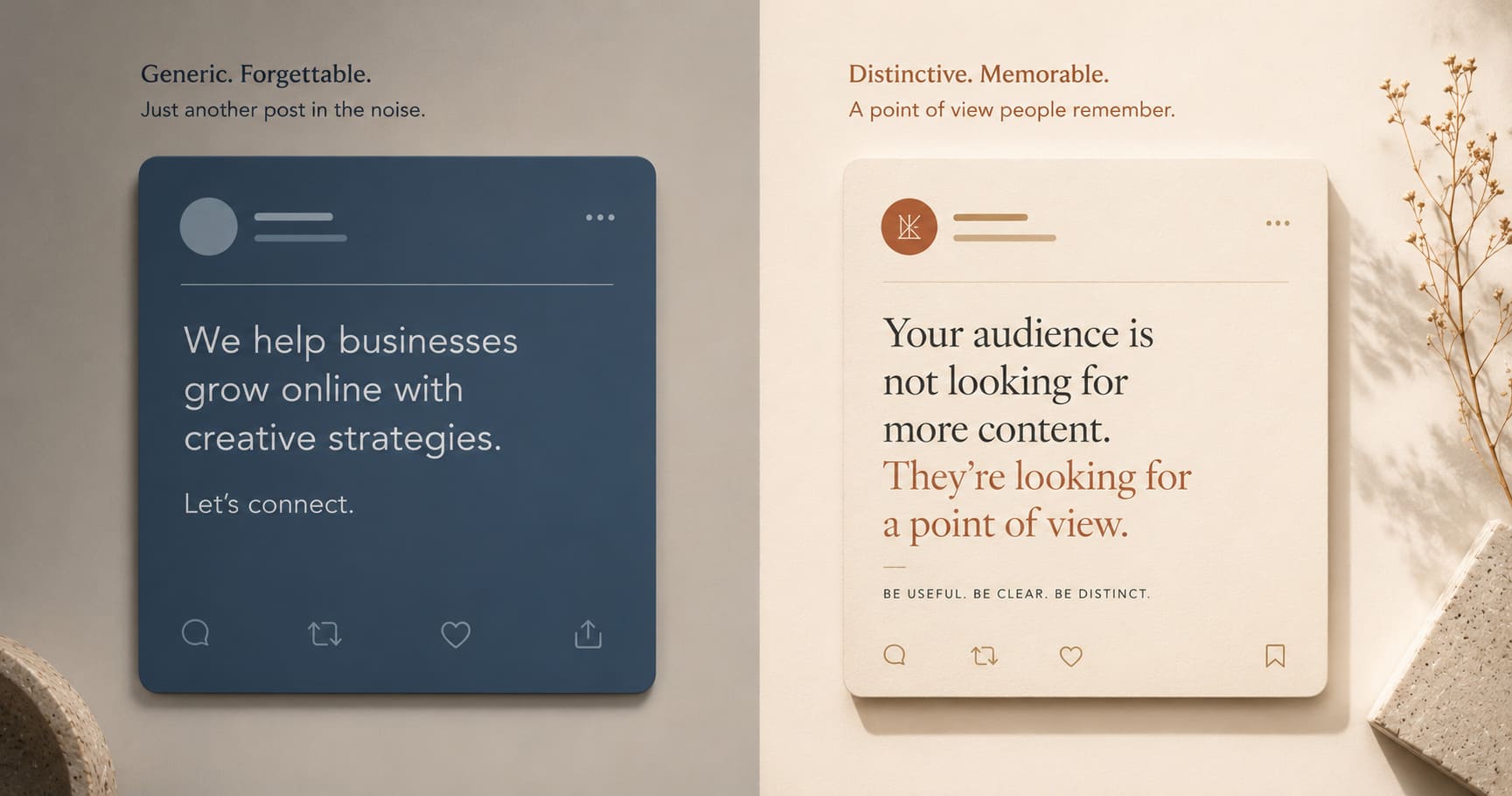
You can disagree with all of those positions. That's the point. A brand voice that nobody disagrees with is a brand voice that nobody remembers.
Why it matters for SEO — specifically
The SEO argument for brand voice is underrated. Most people talk about keywords and backlinks. The harder-to-replicate advantage is editorial identity.
Google's EEAT framework — Experience, Expertise, Authoritativeness, Trustworthiness — rewards content that demonstrates genuine knowledge and a specific perspective. Content with a named author who takes positions, cites real experience, and writes with evident expertise performs better than content that aggregates general information from other sources. This is not a speculation. It's been the consistent direction of Google's ranking signals for several years.
More recently, AI-generated answer engines — Perplexity, ChatGPT, Google's AI Overviews — are selectively citing sources. The content they cite shares specific characteristics: original claims, named authors, verifiable data, a clear point of view. Content that is generic gets summarised into nothing. Content with a specific argument gets quoted.
If your brand is trying to become visible in the AI search layer — which is where a growing share of B2B research now happens — having a voice is not a branding consideration. It's an SEO one. We've written about this dynamic in more depth in our piece on the 2026 state of digital marketing in India.
The three ways voice gets stripped out
In the brands we've worked with, voice tends to disappear at three specific points:
At the brief stage. The brief says "write an article about [topic], 800 words, SEO-optimised, professional tone." There's no position in that brief. There's no reason a reader would finish the piece. A brief that doesn't contain the brand's specific argument on the topic will produce content that doesn't contain it either.
At the editing stage. The writer produces something with an edge. The editor softens it. "We don't want to come across as too aggressive." "This might put off some clients." "Can we make this sound more neutral?" Every hedge removes voice. By the final draft, the piece has been professionally sanitised into anonymity.
At the approval stage. The founder or marketing head reviews the piece and removes everything that sounds like an opinion, worrying that it might be wrong, or too direct, or might offend someone. What they're actually removing is everything that would make a reader remember the piece.
The solution to all three is the same: decide in advance what positions the brand holds, document them, and use them as the filter for every piece of content rather than an afterthought.

Building voice: the practical version
A brand voice document doesn't need to be long. The most useful ones I've worked with run to three pages. They answer five questions:
What does this brand believe? Not the mission statement. The actual convictions — the things the founders would say in a room of industry peers even if it made the room uncomfortable.
What does this brand push back on? The received wisdom in the category that the brand thinks is wrong, incomplete, or oversold. This is where voice becomes specific enough to be memorable.
What vocabulary defines us? Not just "use simple language" — actual words and phrases the brand uses consistently, and words and phrases it avoids because they're generic, overused, or inconsistent with the brand's positioning.
Who are we talking to, specifically? Not "business owners" or "marketing professionals." One person, described in enough detail that a writer could imagine them reading the article.
What do we want them to think after reading? Not "aware of our services." One specific shift in understanding or perspective.
This document, applied consistently, is what produces content that sounds like a brand rather than a category.
The social media version of this problem is even more visible. Scroll through the Instagram or LinkedIn of a typical Indian SME and you'll see the same rotation of content: festival greetings, motivational quotes, product features, "we're hiring" posts. The brand is present but saying nothing. The irony is that Indian social audiences respond well to brands with personality. The brands building real audiences aren't the ones posting most often — they're the ones posting with a clear perspective. We cover the specifics of this in our social media marketing approach.
What happens when you fix it
The brands that develop and stick to a real voice see three things change:
Content starts performing better on search. Not because of any technical change, but because content with a specific point of view earns more engagement, generates more return visits, and attracts links from people who found it genuinely useful rather than just topically relevant.
Sales conversations get faster. When a prospect has already engaged with your content and it accurately represents how you think, the first meeting starts at a much higher level of mutual understanding. You're not explaining your philosophy — they've already read it. This is the function that Human-in-the-Loop content is designed to support: content that builds trust before the first call.
The content itself gets easier to produce. Once the positions are documented, briefing a writer is straightforward. The writer knows what the brand thinks, what vocabulary to use, who they're talking to, and what a good piece looks like. The volume of editing required drops significantly. The quality goes up.
Your audience should recognise you before they see your handle. If they can't, you haven't built a voice — you've built a publishing schedule.
The voice deficit is fixable. It's not a budget problem or a team-size problem. It's a decision problem — the decision to have positions, document them, and trust that saying something specific will attract the right people and repel the wrong ones. That's a good trade.
If your content is producing traffic but not recognition — or recognition but not trust — the content strategy work we do at Artisan Creatives usually starts here. Not with a keyword audit. With the question of what the brand actually believes.