The Honest Guide to Hiring a Digital Marketing Agency in India
Sai Digbijay Patnaik | Jun 29, 2026
Co-Founder

⚡ The Artisan Summary
- → The Core Problem: Most Indian brands hire agencies based on price, case studies, and the quality of the sales pitch — none of which predict whether the work will actually move the needle for their specific business.
- → The Strategy: Evaluate agencies on their methodology, who actually does the work, and their willingness to set measurable commitments — not on how many awards they've won or how big their client list is.
- → The Impact: Asking the right questions before signing reduces the probability of a costly mismatch and sets the conditions for an agency relationship that actually produces results.
The Indian digital marketing industry is large, fragmented, and almost entirely unaccountable. There is no standard credential, no shared definition of results, and no objective way for a buyer to compare two agencies from the outside. A firm with a polished website and a Mumbai address might outsource everything to freelancers. A boutique studio in Berhampur might be producing the most rigorous work in its category. You can't tell from the brochure.
This guide is for founders, marketing heads, and business owners who are about to hire a digital marketing agency and want to avoid the six-months-of-wasted-retainer outcome that is disturbingly common. It won't make the decision for you. It will help you ask the questions that actually matter.
The problem with how most hiring decisions get made
Most agency searches follow the same path. Someone gets a recommendation or finds a few names from a Google search. They look at websites. They look at client logos. They ask for a proposal. They pick the one with the most impressive case studies, the best price, or the most confident pitch. They sign a three-month contract.
Two months in, they realise the case studies were from a completely different industry, the person who pitched them is not the person doing the work, and the "strategy" they were promised is actually a templated service package with their logo on the cover sheet.
This isn't a story about bad agencies. It's a story about a hiring process that selects for presentation over substance. The fix is to change what you're evaluating.
An agency that doesn't publish content of its own — that has no Atelier, no blog, no point of view on its own industry — is an agency that is selling you something it doesn't practice.
Before you evaluate anyone else, it's worth evaluating yourself. Run your own site through our free Content Audit Checklist — twenty-five questions that surface exactly where your foundation is leaking, so you walk into agency conversations knowing what you actually need fixed.
Seven questions that actually matter
1. Who will actually be doing the work on my account?
Not who is in the room for the pitch. Who is going to write your content, manage your campaigns, and review your analytics on a Tuesday afternoon. Ask for their names. Ask to speak with them before signing. An agency that won't introduce you to the people who will handle your account before you've committed is telling you something important.
2. Can you show me work you've done for a business similar to mine?
Not similar in size or geography — similar in problem. A B2B SaaS company in Pune and a D2C food brand in Mumbai have almost nothing in common from a marketing strategy perspective, even if they're both "Indian companies." Ask for examples where the challenge resembles yours. If they don't have any, that's information. It doesn't disqualify them, but it means you're paying for their learning curve as well as your results.

3. What will you do in month one, specifically?
Not "we'll do an audit and develop a strategy." What will that look like? What will you deliver? What decisions will you make and on what basis? A vague answer to this question means the agency is either not sure yet (fine, if honest) or has a templated onboarding process that will look the same regardless of your situation (not fine). The first month of any engagement sets the standard for everything that follows.
4. What does success look like at six months, in numbers?
Not "improved brand awareness" or "stronger digital presence." What metric, measured how, at what threshold, in what timeframe? Agencies that resist this question are protecting their ability to claim success regardless of outcomes. Agencies that engage with it seriously — even if they push back on your assumptions — are the ones worth working with. For paid campaigns specifically, we've laid out how we think about this in our performance marketing approach.
5. How does your methodology actually work?
Not the diagram on slide 7. How does it work, in plain language, for a business like mine? What's the thinking behind your SEO strategy — not "we do on-page and off-page SEO," but what content decisions will you make and why? What does your content production process look like — who briefs, who writes, who reviews, and what standard does something need to meet before you publish it under our name? The quality of the answer tells you whether the methodology is real or a sales artifact.
6. What won't you do, and why?
This is often the most revealing question. Agencies that will do anything to win a client are agencies that haven't developed genuine expertise in anything. The best agencies have a clear sense of what they're good at and what falls outside their competence. An honest "we're not the right fit for X" is more reassuring than "we can definitely help you with everything."
7. What do you publish yourself?
This one is underused. An agency that produces its own thought leadership — that maintains a blog, publishes research, takes public positions on strategy questions — is demonstrating that it actually thinks about the work. The content doesn't need to be award-winning. It needs to exist and to be genuine. An agency with no published content of its own is selling you a capability it doesn't practice. That's worth knowing before you sign.
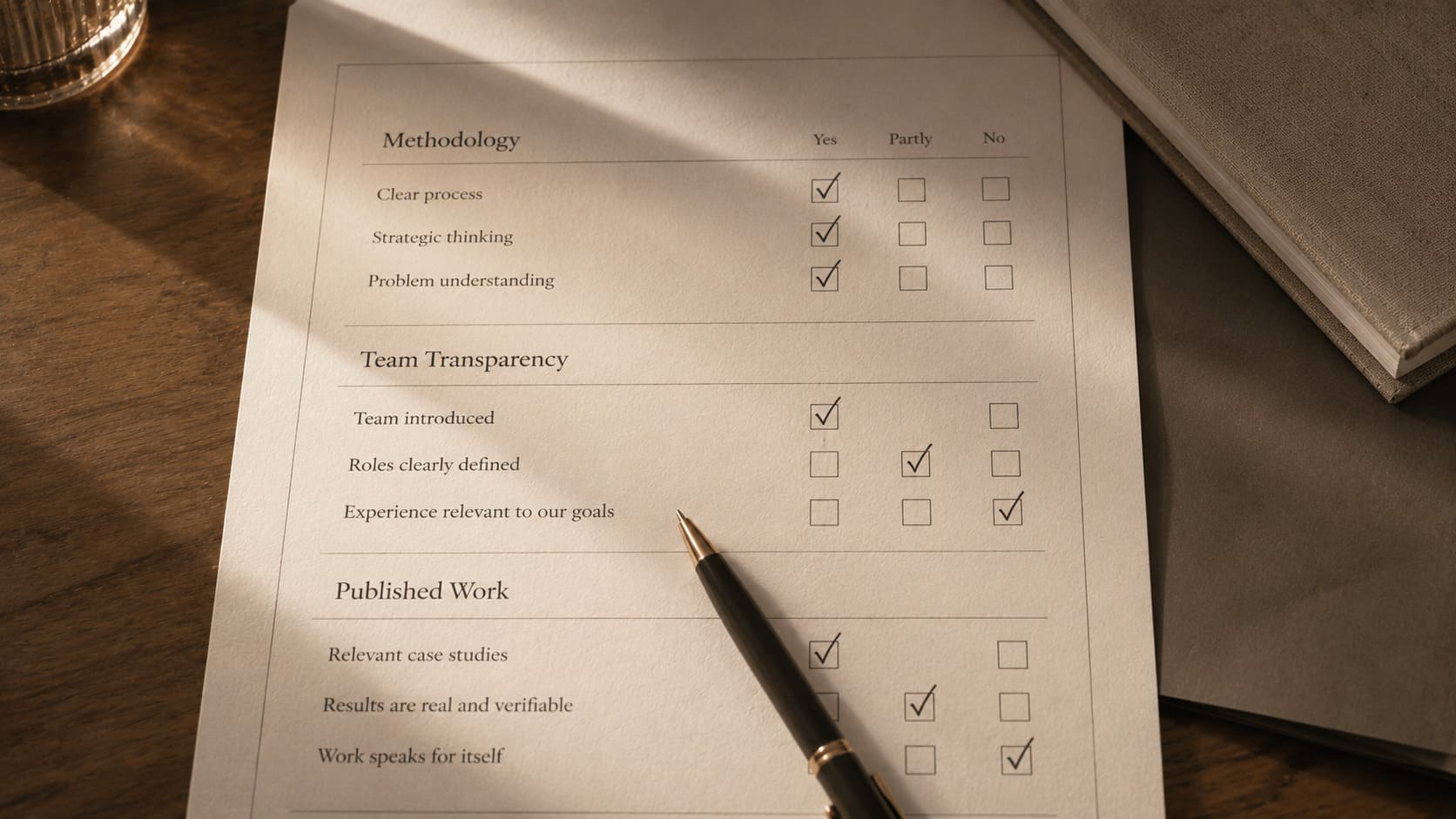
The red flags that are easy to miss
Guaranteed rankings. No legitimate SEO agency guarantees specific rankings. Google's algorithm is not something any agency controls. Agencies that promise position #1 for a set of keywords are either misleading you or planning to use tactics that will eventually get your site penalised. The honest version of what SEO actually delivers is more complex and more durable than any ranking guarantee.
Results in 30 days. SEO compounds over months. Content authority builds over years. Paid campaigns need 4–8 weeks of data before they can be meaningfully optimised. Any agency promising significant organic results in 30 days is either working with a very unusual site advantage or is misrepresenting what "results" means.
Packages rather than strategy. The ₹15,000/month "Social Media Package" with "20 posts per month and monthly reporting" is not a strategy. It's a commodity service that will look the same on your account as it does on every other account the agency manages. If the proposal doesn't reference your specific goals, your specific audience, and your specific competitive situation, it was written before the discovery call ended.
No transparency on who does what. Large agencies often have impressive senior leadership and less-experienced delivery teams. The person who wins your business is rarely the person who manages it week to week. Ask explicitly about this. Not accusatorially — just as a practical question about who you'll be working with.
The size question
There is a version of "bigger is safer" that makes sense in some contexts. For digital marketing, it's worth interrogating.
A large network agency has significant resources, broad capabilities, and established processes. It also has overheads that get passed to the client, account management layers that create distance between you and the thinking, and a volume of clients that makes it structurally difficult to give any single account genuine strategic attention.
A boutique agency has the opposite profile. The senior people are closer to the work. The account list is smaller, which means yours gets more attention. The tradeoff is that their resources are more limited and their processes may be less mature.
The right answer depends on what you actually need. If you're running a ₹50 lakh/month paid media budget across six markets, you probably need the infrastructure of a large agency. If you need a genuine strategic partner who will think seriously about your brand's specific challenges — and who can build a content engine, an SEO architecture, and a paid acquisition strategy that all connect — a boutique that operates with genuine craft and accountability is often a better fit.
The question is not "how big is the agency?" It's "who will actually be thinking about my brand, and how much of their attention do I get?"
What we tell prospective clients about us
Since this is an Artisan Creatives article, it's only fair to apply the same standard to ourselves.
We are a small agency. The people who pitch you are the people who do the work. We are based in Berhampur, Odisha, which is not where most Indian marketing agencies are based — and that geographic reality shapes how we think about Indian markets outside the Bengaluru-Mumbai bubble.
We have a genuine methodology — Human-in-the-Loop content production, SEO built around content authority rather than tricks, and paid campaigns tied to revenue rather than impressions. We write about what we do in The Atelier, which is how you can evaluate whether our thinking aligns with yours before we've spoken.
We take on a small number of clients at a time. We will tell you if we're not the right fit, and we'll do that at the beginning of the conversation rather than after three months of disappointing retainers.
That's the honest version. Apply the same standard to any agency you're evaluating — including us. The questions in this guide work in every direction.
If you're ready to talk, start the conversation here. If you're not sure yet, The Atelier has more of the thinking behind how we work.